Guides
Language
EnglishCurrency
US dollar · $GetYourGuide uses the currency you choose.
Guide · Biology
Is a whale shark a whale or a shark?
Is a whale shark a whale or a shark? A shark: a fish with gills and a skeleton of cartilage that got its name from its size. Here is what sets it apart from whales and from other sharks.
Editorial team, oslobwhalesharkwatching.comUpdated October 22, 2026Reading time 6 min34 sources
Short answer
A shark with a whale's name
The name is the whole source of the confusion. It refers to the animal's appearance and large size; the whale shark is a fish, not a mammal, and like all sharks it is not closely related to whales.1 It is a cartilaginous fish like every other shark, and a filter feeder like the basking shark.910 The animal you meet at Oslob is a giant among sharks, not a cousin of the humpback.
In the Philippines the species goes by other names that avoid the problem. It is called butanding and balilan, and it appears on the reverse of the Philippine 100-peso bill.11 In Visayan, the language of southern Cebu, it is tuki-tuki.12 You may hear those words on the beach at Tan-awan.
So when someone asks whether a whale shark is a whale or a shark, the answer is not a matter of opinion or of definitions. It is a shark by every test that matters: how it breathes, what its skeleton is made of, how its young are born and where it sits on the tree of life. The rest of this page walks through those tests one by one, with what you can actually observe from a boat or with a mask on at Tan-awan.
A long life
From pup to giant
Gills against lungs
The quickest way to tell a fish from a whale is to watch how it breathes. Whales evolved from land-living mammals and must regularly surface to breathe air.18 They take in and expel that air through blowholes on top of the head.3 A whale shark has five large pairs of gills instead, and takes its oxygen from the water flowing over them.2
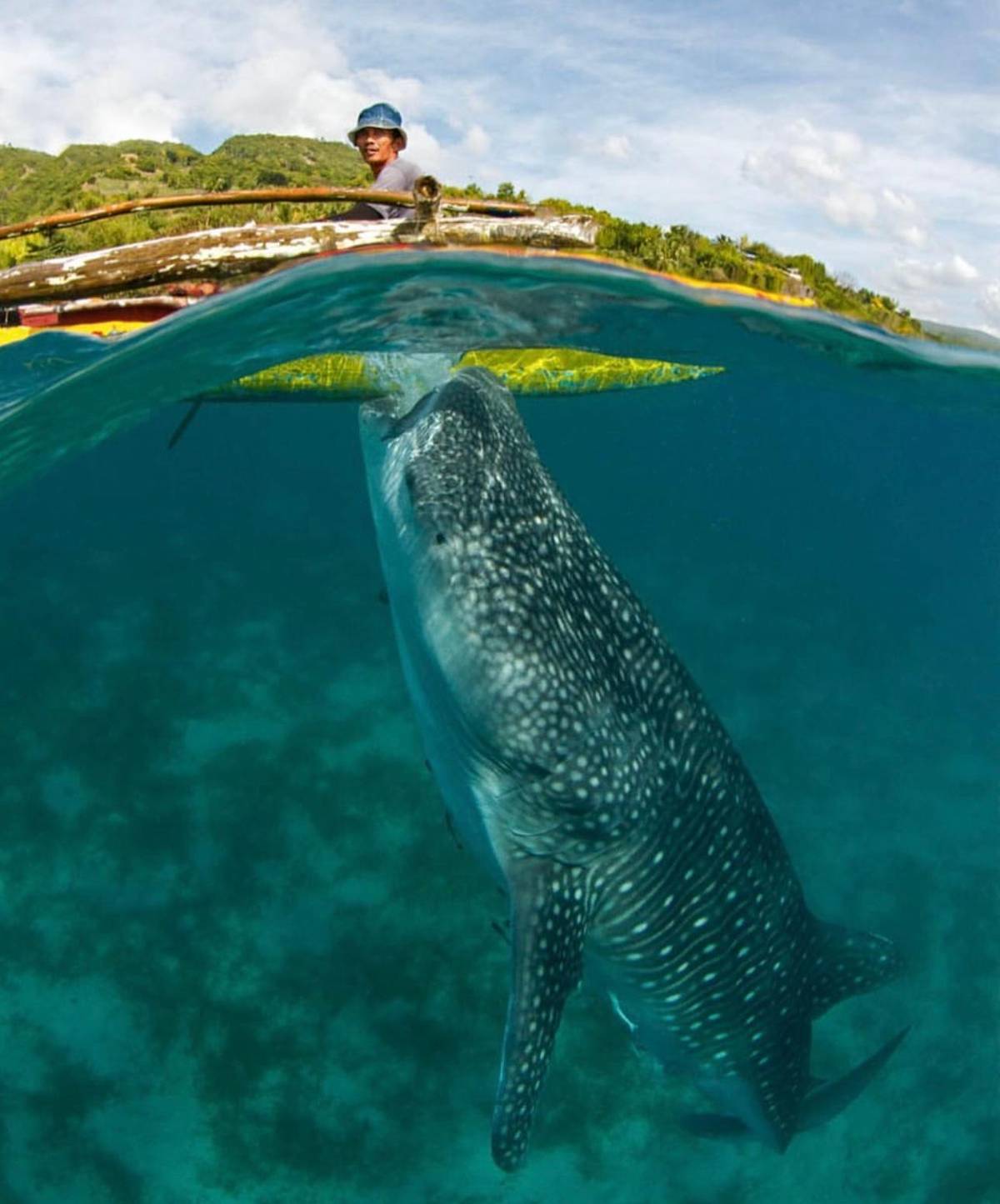
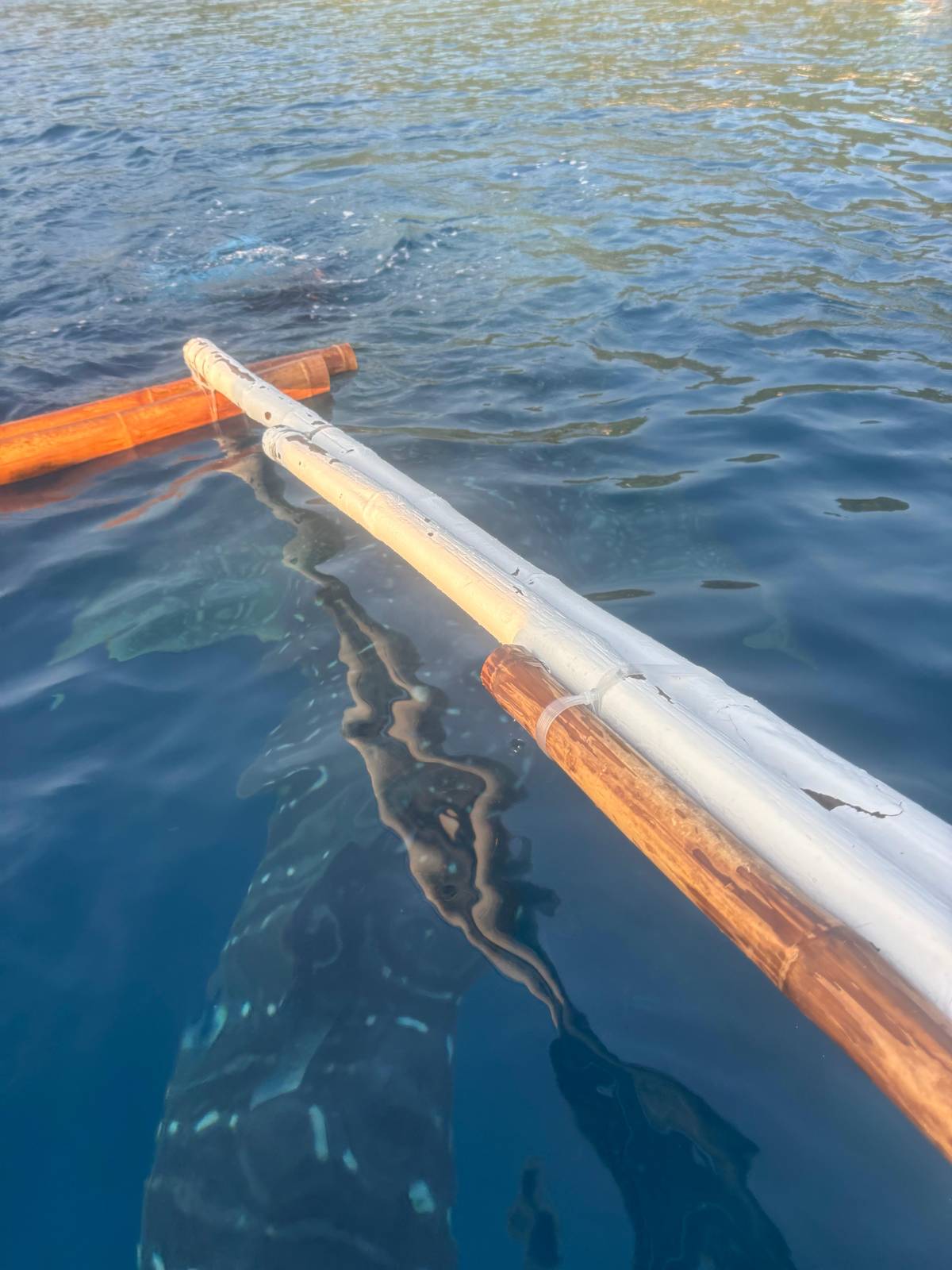
You can see that difference at Oslob. A feeding whale shark hangs in the water with its head near the surface and gulps, and the water leaves through the long slits on the sides of its head. It never needs to come up for air, which is why it can stay with the feeder boats for long stretches. A whale, by contrast, would show you its blow.
The skeleton tells the same story. Sharks are cartilaginous fishes with a ribless skeleton, skin covered in tooth-like scales called denticles, and five to seven gill slits on each side.9 In the whale shark that skeleton is thick, flexible cartilage with no rib cage at all.19 A blue whale, a member of the class Mammalia, has bones, ribs and lungs like ours.20
Three giants compared
Whale shark, white shark, blue whale
| Feature | Whale shark | White shark | Blue whale |
|---|---|---|---|
| Group | Fish (shark) | Fish (shark) | Mammal |
| Breathes with | Gills | Gills | Lungs, via blowholes |
| Skeleton | Cartilage, no ribs | Cartilage, no ribs | Bone |
| Teeth | Up to 300 rows, tiny | Around 300 | None (baleen) |
| Feeds by | Filtering | Hunting | Filtering krill |
| Size rank | Largest fish | Smaller than whale shark | Largest animal ever |
From the natural history sources cited on this page; blue whales are baleen whales of the class Mammalia.19196222324203
Spot the difference
Whale or shark? Check these signs
What you can see from the boat or in the water
Whale sharks breathe through five pairs of gills.2
Whales breathe air through blowholes.3
Like other sharks, it is a fish with a cartilage skeleton.9
Suction feeding happens in a vertical or horizontal position.25
Whale sharks carry a pattern of pale spots and stripes on a dark back.
The name "whale shark" refers to the animal's appearance and large size; it is a fish, not a mammal, and, like all sharks, is not closely related to whales.
Shark vs whale shark: what makes it unusual among sharks
Comparing a shark vs whale shark is really comparing a hunter with a filter feeder. Most sharks catch prey with their teeth, while the whale shark gulps water and filters plankton, fish eggs, crustaceans and schooling fish from it, and only occasionally larger prey like squid or tuna.26 It shares that habit with the basking shark, the other giant filter-feeding shark.10
Size is the other big difference. The white shark, the best-known predator among sharks, is one of the largest living sharks, yet it is still smaller than the whale shark and the basking shark.23 The whale shark is the largest living fish, with a maximum size thought to be about 20 m.4 The largest individual reliably recorded measured 18.8 m.5
Feeding style shapes the body. The whale shark's mouth sits at the very front of a broad, flat head and can measure up to 1.5 m across.6 It feeds by suction, opening its mouth forcefully and gulping prey, often while stationary in a vertical or horizontal position.25 That upright posture is exactly what visitors see beside the feeder boats at Oslob.
In the water
What to look for at Oslob
Body
- Gill slits along the side of the head
- White spots and stripes on a dark back
- A wide, flat mouth at the front
Behaviour
- Hanging upright near the feeder boats
- Gulping water at the surface
- Calm, slow swimming past people
Video
The Amazing Biology of the Whale Shark
Nothing loads from YouTube until you press play.
Hundreds of tiny teeth that do almost nothing
The whale shark does have teeth, a great many of them. Its mouth holds up to 300 rows of hundreds of tiny, hooked and replaceable teeth.6 Yet these teeth seem to play little if any role in feeding.7 The real work is done by filter pads in the throat: there are 20 of them, and they let the shark sift an average of 20,723 grams of plankton a day.27
Those pads are fine enough to hold prey as small as 1 mm.7 A juvenile whale shark is estimated to eat 21 kg of plankton a day.28 For comparison, a white shark has around 300 teeth in rows that move forward like a conveyor belt as old ones are lost.22 Its teeth cut; the whale shark's are hardly used.
At Oslob you will not see the teeth at all. What you will see is the open mouth and the gill slits working as the shark takes in water near the feeders. Watching from the side, at the distance the rules require, is the best view of that filter-feeding at work. Look for the moment the mouth closes: the gill slits flare as the water is pushed out, and whatever the shark wanted stays behind on the pads.
Is a whale shark dangerous to people?
Despite its size, the whale shark is considered harmless to humans and will often interact calmly with divers.268 The same natural history profile notes a few cases of whale sharks ramming sportfishing boats, possibly after being provoked.8 It adds that the sharks are usually more at risk of being struck by vessels while basking or feeding at the surface.29
That contrasts sharply with the white shark. Among shark species, it is responsible for the largest number of recorded bites on humans, with 351 documented unprovoked bites since 1580 as of 2024.30 A whale shark has neither the teeth nor the hunting behaviour for that, and our sources record no such attacks.
Harmless does not mean you can ignore it. A large shark moves a lot of water with its tail, and the Oslob rules keep you 5 m from the side and tail.31 Respect the distance and the encounter stays calm for both of you.
How whale sharks are born and grow
Whale sharks give birth to live young. A 10.6 m female harpooned off Taiwan in 1995 carried about 304 embryos between 42 and 63 cm long.32 Pups are born at an average length of 55 cm, and the smallest live whale shark ever recorded, 38 cm, was found in the Philippines.13 That tiny shark was found on 7 March 2009 tied to a stake on a beach in Pilar, Sorsogon, and released.33
Growing up takes a long time. Researchers suggest sexual maturity may take up to 30 years, and both sexes reach maturity by about 9 m in length.164 Age estimates reach 60 years, though no one really knows how long whale sharks live, and one university account suggests lifespans beyond 100 years.1734
This puts the Oslob sharks in context. The whale sharks identified there measured 5.3 m on average, from 2.5 to 9.0 m, and most were males.15 Coastal feeding sites around the world hold mainly juvenile males.14 The sharks you see in Oslob are, for the most part, young animals still far from full size. Even so, a juvenile longer than a small car is an overwhelming sight from a mask, and it is easy to misjudge how close it is.
Pick your date
Whale sharks at dawn, a canyon by afternoon
Hotel pickup, the whale shark fee, lunch and a canyon guide; cancelling is free until a day before.


You ask,we answer.
Is a whale shark a mammal?
No, it is a fish. It is a shark, not a mammal, and not closely related to whales.1
Has a whale shark ever killed a human?
Our sources record no such case. It is considered harmless to humans; a few have rammed sportfishing boats, possibly when provoked.8
How many teeth does a whale shark have?
Hundreds, in up to 300 rows. They are tiny and seem to play little if any role in feeding.67
Is the whale shark the biggest fish?
Yes, the largest living fish. The largest reliably recorded individual measured 18.8 m.45
Is a blue whale bigger?
Yes. Blue whales are the largest animals ever to live on the planet.24
What does a whale shark eat?
Plankton and small fish. It filters plankton, fish eggs, crustaceans and schooling fish, occasionally squid or tuna.26
How big are the Oslob whale sharks?
About 5.3 m on average. Sizes ranged from 2.5 to 9.0 m in the three-year study.15
Sources
Evidence for this guide
- 1WikipediaWhale shark↩
- 2WikipediaWhale shark↩
- 3WikipediaWhale↩
- 4Florida Museum of Natural HistoryRhincodon typus (whale shark), species profile↩
- 5WikipediaWhale shark↩
- 6Animal Diversity Web, University of MichiganRhincodon typus: whale shark↩
- 7Animal Diversity Web, University of MichiganRhincodon typus: whale shark↩
- 8Florida Museum of Natural HistoryRhincodon typus (whale shark), species profile↩
- 9WikipediaShark↩
- 10WikipediaShark↩
- 11WikipediaWhale shark↩
- 12Florida Museum of Natural HistoryRhincodon typus (whale shark), species profile↩
- 13Animal Diversity Web, University of MichiganRhincodon typus: whale shark↩
- 14Florida Museum of Natural HistoryRhincodon typus (whale shark), species profile↩
- 15Royal Society Open Science (Thomson et al. 2017)Feeding the world's largest fish: highly variable whale shark residency patterns at a provisioning site in the Philippines↩
- 16Animal Diversity Web, University of MichiganRhincodon typus: whale shark↩
- 17Florida Museum of Natural HistoryRhincodon typus (whale shark), species profile↩
- 18WikipediaWhale↩
- 19Animal Diversity Web, University of MichiganRhincodon typus: whale shark↩
- 20NOAA FisheriesBlue whale↩
- 21Animal Diversity Web, University of MichiganRhincodon typus: whale shark↩
- 22WikipediaGreat white shark↩
- 23WikipediaGreat white shark↩
- 24NOAA FisheriesBlue whale↩
- 25Animal Diversity Web, University of MichiganRhincodon typus: whale shark↩
- 26Florida Museum of Natural HistoryRhincodon typus (whale shark), species profile↩
- 27Florida Museum of Natural HistoryRhincodon typus (whale shark), species profile↩
- 28WikipediaWhale shark↩
- 29Florida Museum of Natural HistoryRhincodon typus (whale shark), species profile↩
- 30WikipediaGreat white shark↩
- 31Royal Society Open Science (Legaspi et al. 2020)In-water observations highlight the effects of provisioning on whale shark behaviour at the world's largest whale shark tourism destination↩
- 32Animal Diversity Web, University of MichiganRhincodon typus: whale shark↩
- 33WikipediaWhale shark↩
- 34Animal Diversity Web, University of MichiganRhincodon typus: whale shark↩
Keep reading